20250813_13105622-960x1149

The Trail of Genghis Khan

Mongolia

3000 

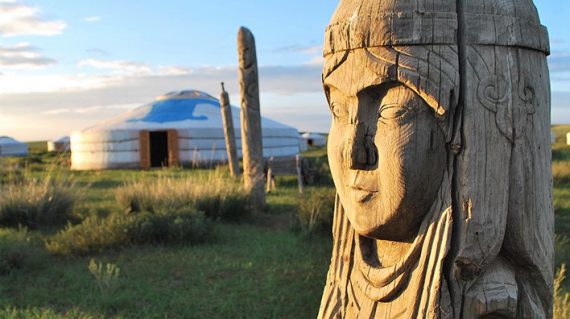
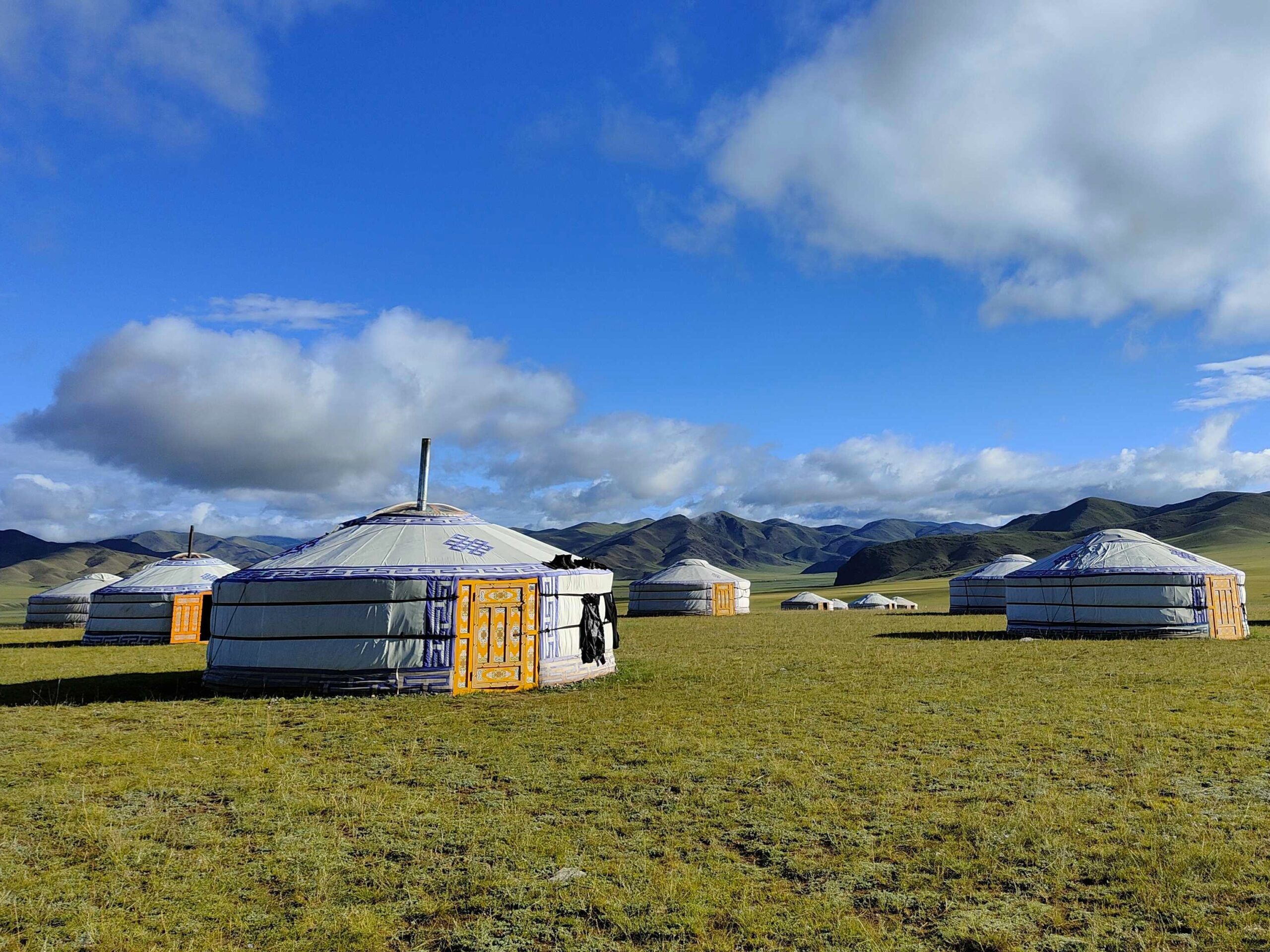
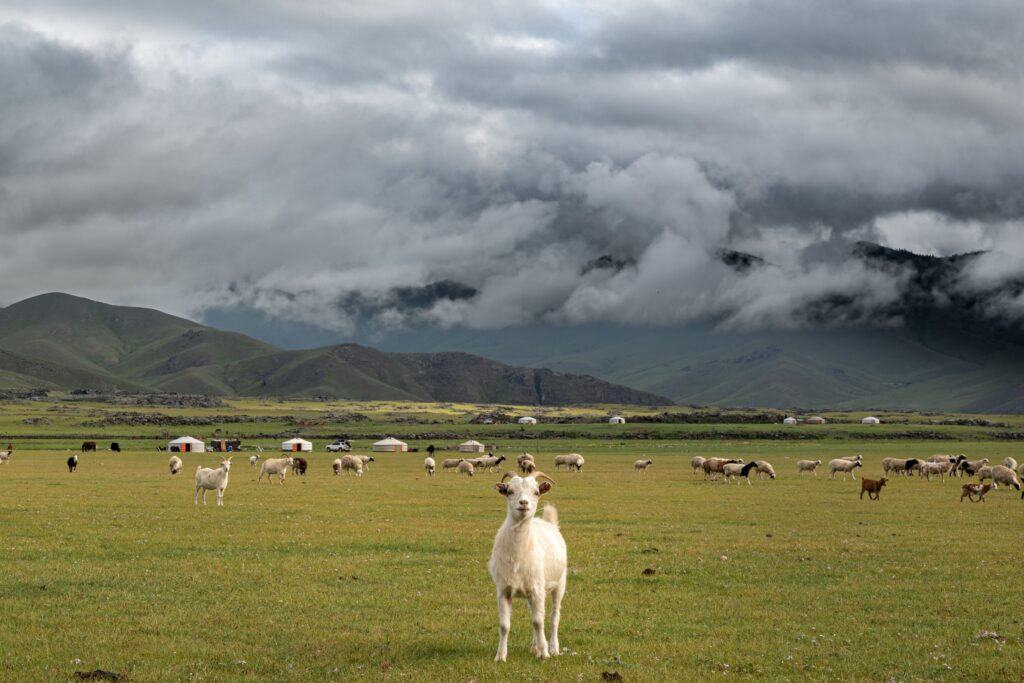
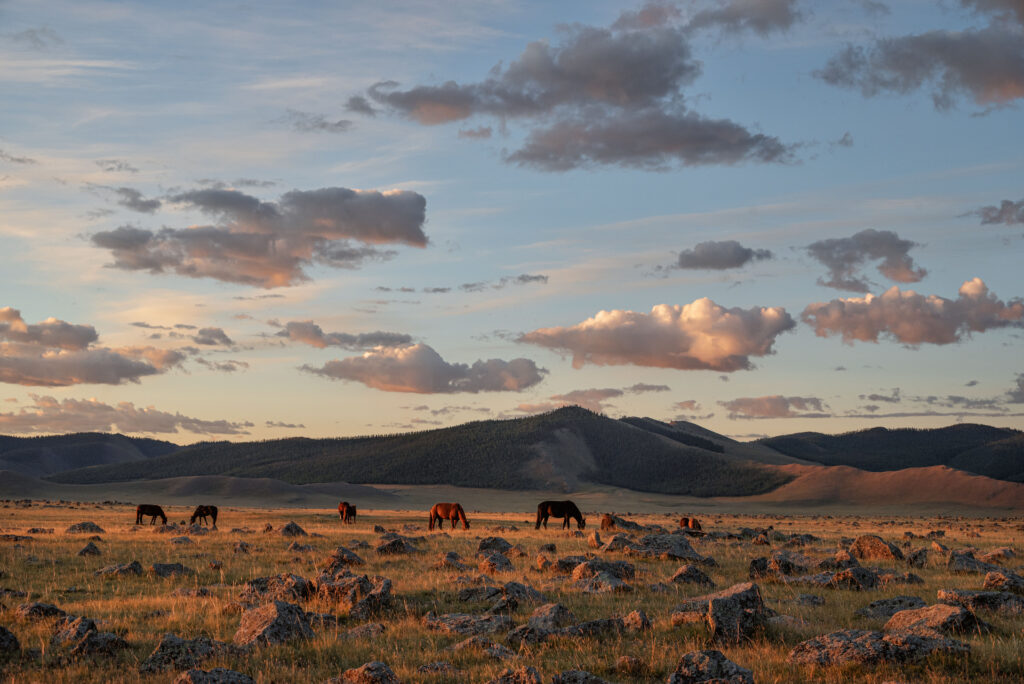
The green grasses of the Great Steppe stretch far into the distance, all the way to the horizon. A sharp-eyed rider can easily spot herds of horses, cattle and sheep grazing near the gers, the traditional Mongolian yurts. Not far to the west rise the monumental peaks of the Khangai Mountains, and in their shadow grows the taiga forest, scented with larch. The horses snort quietly. We have come from Karakorum, and a long road lies ahead – all the way to the White Lake. Mount up and let’s ride!

  • Days overall
    16 days
    Days in saddle
    10 days
  • Group size
    12
    Available
  • Standard
    nomadic style (gers and tents)
    Luggage
    no limit kg
    Food
    local cuisine, limited vegetarian option
  • Skills
    walk, trot, gallop

Ahead of us lies the legendary Mongolia. Genghis Khan, one of the most outstanding nomadic leaders in world history, started his campaigns, marched west to conquer and then ruled his vast empire from here. It is a land where riders seem to be born in the saddle, and horses are born to gallop across the endless green steppe.

Following our Trail of Genghis Khan is one of those rare adventures that reach far beyond imagination. It is something that has to be experienced, as no description gives it justice. First of all, we will immerse ourselves in the unique culture of the peoples of the Great Steppe, which has survived to this day in the remote regions of Mongolia. This journey is also a trip through the history of the great nomadic empire that influenced the fate of many lands across Asia and Europe.

We will visit the famous Karakorum, see Buddhist monasteries, and above all admire Mongolia’s remarkable nature. Along the way we will cross steppes and pastures, mountains and canyons, lakes, rivers and waterfalls, and even sandy desert landscapes. We will also follow the tracks of takhi, or – as we call them – wild Przewalski’s horses.

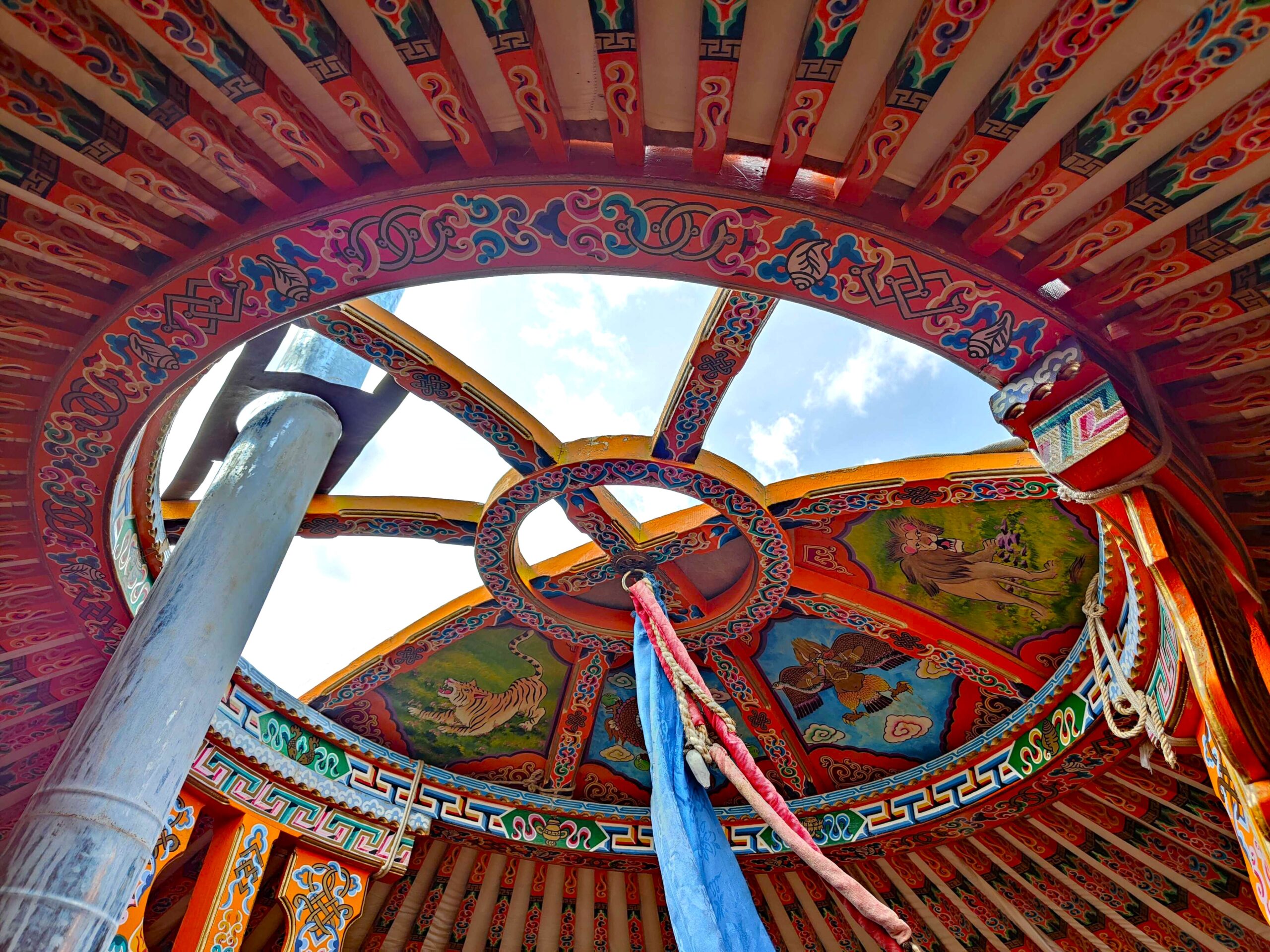
We will spend most nights in touring tents, although we will also stay in gers. A ger is a traditional felt-covered tent, commonly known in the West as a yurt.

Daily riding distances are quite long (around 35–40 km). The terrain is usually relatively easy, and the overal pace on the trail is relatively fast. We ride lightweight, without any luggage on our horses. During the entire tour we are assisted by a supporting vehicle.

This expedition is intended for confident and experienced riders who already have experience in multi-day trails, can handle more demanding horses, and are comfortable in more challenging situations and environments. Our Mongolian rides are not suitable for beginners or riders without previous trail riding experience.

Rider weight limit is 90 kg / 200 lbs.

What is included in this tour?Items that are included in the cost of tour price.
  • 1 night in a hotel in Ulaanbaatar
  • 5 nights in gers
  • 9 nights in tents
  • Full board (excluding alcohol), except in Ulaanbaatar
  • Airport transfers in Ulaanbaatar (on the first and last day of the trail)
  • All vehicle transfers included in the itinerary (4WD vehicles)
  • Entrance fees to all attractions included in the program
  • Traditional dance and throat singing performance
  • Local guide
  • English-speaking tour leader
  • Horse with full tack
  • Camel ride
  • Support vehicle during the trail
  • Camping equipment (tents, sleeping bags, sleeping mats)
  • Travel insurance including high-risk sports coverage
What is not included in this tour?Items that are not included in the cost of tour price.
  • Flights to and from Ulaanbaatar
  • Meals in Ulaanbaatar
  • Personal expenses (souvenirs, additional snacks, alcohol, etc.)
  1. Day 1 First steps in Mongolia

    We arrive in Ulaanbaatar early in the morning (departure from Europe the previous day). We go directly to the hotel to rest for a few hours. At noon we meet our local guide and head to a restaurant for lunch. Afterwards we visit the Genghis Khan National Museum. The exhibition covers the period from prehistoric times to the Soviet era, with a large section devoted to the Mongol Empire and its founder, Genghis Khan. In the evening we take a short walk around the city and attend a performance of traditional Mongolian dance and throat singing. Overnight at a hotel.

  2. Day 2 Karakorum

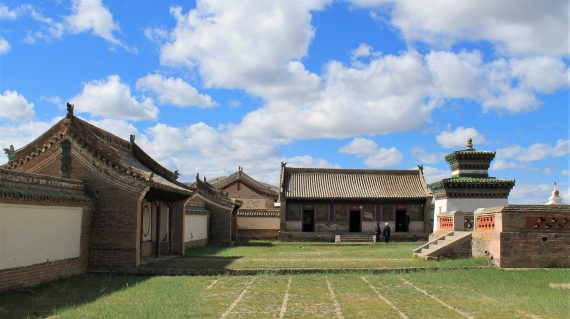
    After breakfast we board 4WD vehicles. The journey takes about 5 hours, and on the way we stop for lunch at a local restaurant. In the afternoon we arrive in Karakorum, the capital of the Mongol Empire, founded as a military camp by Genghis Khan in 1220. The entire site is listed as a UNESCO World Heritage Site. We also visit Erdene Zuu Khiid, the largest and one of the oldest Buddhist monasteries in Mongolia, built in the 16th century. The monastery complex is surrounded by 108 sacred stupas, symbolizing enlightenment. Overnight near Karakorum in tourist gers.

  3. Day 3 Orkhon River Valley

    In the morning we say goodbye to Karakorum and set off in 4WD vehicles toward the beautiful Orkhon Valley, a UNESCO World Natural Heritage Site. We have about 150 km to go, which will take around 4–5 hours. We travel along the river, admiring the endless green pastures and the summer camps of nomadic herders. In the second half of the day we arrive at a local family’s camp, where we join in their daily activities. Our main task is to build a ger using traditional methods, where we will later spend the night.

  4. Day 4 Waterfall

    That day we mount our horses and head out into the steppe. A light ride awaits us, about 15 km, with our destination being the breathtaking Ulaan Tsutgalaan Waterfall. It is believed to have formed over 20,000 years ago as a result of a volcanic eruption and an earthquake. Here the water crashes down from nearly 20 meters onto black volcanic rocks. When the sun is shining, small rainbows often appear at the base of the waterfall. In the afternoon we return to the Mongolian family and spend another night in gers. For dinner we enjoy Khorkhog, a traditional Mongolian barbecue.

  5. Day 5 Footsteps of Zanabazar

    We say goodbye to our hosting family and continue our journey. Today we ride about 35 km in the saddle. The trail leads along a mountain ridge to the 17th-century Buddhist monastery of Tövkhön. It was here that Öndör Gegeen Zanabazar, one of the most important spiritual leaders in Mongolia’s history and the first Jebtsundamba Khutuktu (the head of Tibetan Buddhism in Mongolia), created the Soyombo script, used to write the Mongolian language. According to legend, Zanabazar saw luminous symbols in the sky, wrote them down, and later transformed them into an alphabet. The monastery buildings stand at an altitude of 2312 m above sea level and offer a magnificent panorama of the Khangai Mountains. In the evening we set up camp in the nature and spend the night in tents.

  6. Day 6 Endless steppe

    In the morning we visit Tövkhön Monastery, then cross the Tsagaan Sum River and gradually move into less populated areas. The trail leads across the endless steppe, with mountains visible on the horizon. There will be plenty of opportunities for long gallops. In the afternoon we reach our destination, the Dutut Hills, where we set up our camp at their foot.

  7. Day 7 Off the Beaten Track

    After breakfast we continue our journey. The trail leads us further north and soon we will enter the Tsenkher district. The lay of the land is flat, so we will gallops across the steppe. In the late afternoon we will reach a river bend, where we will cool down our horses. Here we set up camp and spend the night in tents.

  8. Day 8 Northern slopes of Changay

    We ride toward the town of Tsetserleg, the capital of the aimag (province). The origins of the settlement date back to the 17th century and are connected with the construction of the Zayain Khüree Lamaist monastery. The monastery hasn’t survived, it was destroyed by the communists in the 20th century. In the second half of the day we cross a mountain pass to reach our next camping spot at the foot of Mount Khalzan Davaa.

  9. Day 9 Taikhar Rock

    After breakfast we continue north, heading toward the area of the town of Ikh Tamir. Along the way we pass Taikhar Chuluu, or Taikhar Rock. This 20-meter rock formation stands on the bank of the Choid Tamir River in Ikhtamir Soum. It is covered with around 150 inscriptions in many different scripts and languages from various historical periods, including runic, Sogdian, Uyghur, Mongolian, Tangut and Tibetan. The oldest inscriptions are runic and date back to the Turkic period in the 6th and 7th centuries. At the top of the rock stands an ovoo, a traditional sacred cairn used as a place of worship. The rock has been under protection since 1994. We set camp and spend the night in tents.

  10. Day 10 Herds of Horses

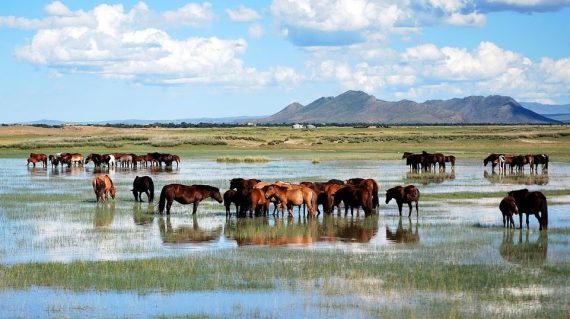
    That day we can expect plenty of trotting and galloping. The terrain is flat – a typical steppe landscape that we already had time to get used to. Along the way we may encounter herds of horses and nomadic families. In the evening we reach a river bend where we can take a swim. Then we’ll set camp and spend another night tenting.

  11. Day 11 Land of Nomadic Herders

    We gradually enter more populated areas. This region is known for having the largest number of yak herds in Mongolia. At a cheerful gallop we reach the town of Öndör Ulaan, where we will be able to resupply for the rest of our journey. Here we’ll also cross a road, which – in these circumstances – is a bit of an unusual experience. Soon after we’ll set camp and stay in tents for the night.

  12. Day 12 Chuluut Gol Canyon

    After breakfast we head toward the Chuluut Gol River, which flows along the bottom of the famous basalt canyon. We stop here for a short break and then gallop across the endless steppe again. In the evening we will set our camp near picturesque cliffs and stay there for the night.

  13. Day 13 White Lake

    This is the last day of horseback riding. We start the day with some faster riding and soon reach the foot of Mount Khorgo, an extinct volcano. The landscape changes completely as the trail leads across vast fields of lava that solidified about eight thousand years ago. Here we leave the horses in a safe place and set off on foot to explore the slopes of the volcano. Our goal is the summit (2210 m above sea level), which offers a truly unique view. On the horizon we will see one of Mongolia’s natural treasures: Terkhiin Tsagaan Nuur, also known as the White Lake, one of the most beautiful lakes in the country. We reach its shore in the afternoon and – for the last time – spend the night in tents.

  14. Day 14 Granite and Sands

    In the morning we say goodbye toour horses and leave by car heading south-east. We cover about 370 km, which takes around 6 hours. Along the way we pass Karakorum and reach Elsen Tasarkhai, also known as the Little Gobi. This is a chain of sand dunes stretching for about 80 km. Here we will enjoy a one-hour ride on Bactrian camels. Well spend the night nearby, in gers.

  15. Day 15 Przewalski's Horses

    After an early breakfast we set off by vehicle toward Ulaanbaatar. We have 250 km ahead of us. On the way we stop at Khustai National Park, where we go for a hike. Our goal is to find and observe a herd of the last truly wild horses in the world, the Takhi – Przewalski’s horses, as we call them. In the afternoon we arrive at a charming campsite near the capital. There will be time to freshen up and warm up, followed by our final group dinner. Overnight in gers.

  16. Day 16 Farewell to Mongolia

    It’s time to leave amazing Mongolia. The whole group will be transferred to the airport.

The guide may modify the route depending on weather conditions and the group's riding skills.
fot. z archiwum przewodnika

The expedition is organised – for a horseback trip, and for Mongolia – in a comfortable and nicely varied way. In Ulaanbaatar we’ll stay in a hotel. Outside the city we’ll spend the nights in gers (traditional Mongolian yurts) as well as in tents. Warm sleeping bags will be provided on the spot. We’ll also have a sanitary “shower” tent with us. Using it depends on water availability at the campsite – if there is a source of water we’ll heat it over the fire. It’s reasonable to assume we will be able to wash at least every other day.

Meals will be prepared – depending on the day – by local host women, our guides, or restaurant cooks. Traditional Mongolian cuisine is rich, quite fatty, and can be heavy on the stomach. Like most pastoral diets, it’s based mainly on animal products: meat and dairy. Expect simple dishes — but tasty, filling, and satisfying.

Meals will be prepared, depending on the day, by local host families, our guides, or restaurant cooks. Traditional Mongolian cuisine is rather fatty and stodgy, based – like most pastoral diets – mainly on animal products such as meat and milk. You should expect simple but tasty and filling dishes.


Equipment

In Mongolia we ride in a locally popular saddles that are, in a way, a hybrid of a russian saddle and a saddle somewhat-similiar to a typical trail saddle. Those saddle are quite comfy and serve well when it comes to long-distance riding. We use bits.

Riding clothing should be adjusted for the climate of the Great Steppe. Daytime temperatures may reach 25°C, but flash storms, rain and fog are likely. In the evening the temperature drops and it can get chilly. Riding clothes and spare clothing should therefore be suitable for changing conditions, and we recommend a layered approach. A good waterproof outer layer is essential. Instead of traditional riding boots, we recommend trekking boots, preferably waterproof. It is also a good idea to bring a scarf or buff to protect your face from dust on dry days.

What you should take with you

On our trail in central Mongolia we are supported by a 4WD vehicle. There is no strict luggage weight limit, but we recommend packing smart and keeping int reasonable. Packing in a hardshell suitcase is fine.

For the daily rides you’ll only need a waist or hip bag for small, personal belongings.

We will provide an extended, detailed packing list with comments and recommendations in an organizational info-email a month prior to the tour.

  • passport
  • cash, preferably USD or EUR
  • electronic equipment, e.g. camera, power bank
  • flashlight, preferably a headlamp
  • sunscreen
  • sunglasses with UV protection
  • layered clothing
  • raincoat / jacket
  • swimwear (optional, for those who would like to swim in rivers)
  • trekking boots
  • knife or pocket knife
  • canteen or reusable water bottle
  • optional: pillow, sheet/sleeping bag liner

Our partner provides good sleeping bags free of charge. They are washed and disinfected after each trail.

Date Trip Status Price Spots  
9 August 2026 - 24 August 2026
Available, English-speaking guide/pilot
3000 
2